

Have each child’s age, weight, and height ready, with weight in kilograms mattering most. Match those numbers to a seat type: infant bucket, convertible, forward-facing harness, or booster. Book when you book your flights, at least 48 hours ahead (a week or more in peak periods). Read the confirmation for the exact seat type per child, and do a two-minute check when the vehicle arrives.
Booking a car seat limo in Toronto is nothing like booking a regular airport ride. A regular ride needs an address and a time. A car seat ride needs those plus a small file on each child. This guide walks through the process the way it actually works, written from the pickup side of the business.
Why booking a car seat ride takes more thought than a regular airport pickup
With a standard airport transfer, the only variable is vehicle size. With a car seat booking, the seat itself is the variable. Several kinds exist, each fitted to a different stage of child, and a provider cannot guess which one yours needs from the word “toddler” alone.
That is the entire game. Precise information in, precise seat out. The smoothest pickups belong to families whose booking notes left nothing to interpret. It has nothing to do with how fancy the vehicle is.
Step 1: Know your child’s numbers before you book
Before you book, get three numbers for each child riding: age, weight, and height. Weight matters most. Seat types are defined by weight ranges first and age second, so “she’s four” does not tell a dispatcher which seat to send.

Weigh your child the week you book. Children grow in jumps, and the most common booking error we see is a seat ordered for the child of three months ago. If a birthday falls between booking and travel day, note it. A good provider will flag whether it changes the seat.
Your pre-booking checklist
- Each child’s age, weight in kilograms, and height. Weight in kg is the number dispatchers work with. Convert from pounds if that is what your scale shows.
- How many children need seats, and whether any child is old enough for a seatbelt alone.
- Anything unusual: twins, a child with special positioning needs, or a seat type your child refuses to sit in.
- Your own seat, if bringing one: its type, and whether you want it installed for you.
Do not guess the weight. A bathroom scale and thirty seconds beats a confident estimate.
From our dispatch desk: the most common mistake is leaving out the child’s age and weight. Without both, we can’t match the right seat. Give us each child’s age and current weight when you book. If you’re not sure which seat type fits, you can see the seats we carry before you call.
Step 2: Match those numbers to the right seat type
Four seat types cover every booking, each mapped to a weight range. Ontario law sets the minimums (rear-facing to at least 9 kg, forward-facing harness from 9 to 18 kg, boosters from 18 to 36 kg until the child is 8, 36 kg, or 145 cm), and our Ontario car seat laws guide covers the legal details. For booking purposes, here is what each type means in practice.
| Seat type | Weight range | Typical stage |
|---|---|---|
| Infant bucket seat (rear-facing only) | Under 9 kg | Newborns and young babies, first 12 to 15 months |
| Convertible seat | Rear-facing to at least 9 kg, then forward-facing | Older babies and toddlers, roughly 1 to 4 |
| Forward-facing seat with harness | 9 to 18 kg | Toddlers and preschoolers who have outgrown rear-facing limits |
| Booster seat (high-back or backless) | 18 to 36 kg, until age 8, 36 kg, or 145 cm | Roughly ages 4 to 8 |
Two booking tips worth naming: say “infant bucket, rear-facing” explicitly rather than just “baby seat,” and ask whether a convertible will be supplied rear- or forward-facing. That single question prevents the most common mismatch.
Between two sizes? Tell the provider both numbers and ask. Most dispatchers err toward the more protective option, and they would rather have that conversation at booking than at your front door.
Step 3: Book early, and know what “early” means
Book when you book your flights. Car seats are physical inventory. A company has a finite number of each type, and on peak days they go out with the morning’s first pickups. March break, Christmas week, and long weekends drain the shelf fastest.
Practical rule: 48 hours ahead is a comfortable minimum. Give it a week or more for peak periods or multiple seat types. Same-day is sometimes possible, but you get whatever seat is on the shelf. Not necessarily the right one for your child. For infants, same-day is a gamble not worth taking.
What to include in the booking itself
- Child details: each child’s age, weight, height, and the seat type you are requesting.
- Trip details: pickup and drop-off addresses, date, and pickup time.
- For airport pickups: terminal (T1 or T3 at Pearson; a driver at one cannot quickly reach the other), airline, and flight number.
- Return leg: book both ways now. Return seats are separate inventory.
- Luggage and gear: suitcase and stroller count, since installed seats eat trunk space.
- A contact number answered on travel day.
The flight number matters most here: a provider that has it can track your flight and adjust for delays. One that does not is driving blind.
Step 4: Read the confirmation like a contract
A proper confirmation tells you more than a time and an address. Read it the way you would read anything you are trusting your child to, and treat vagueness as a warning sign.
A confirmation worth trusting includes
- The exact seat type per child: “rear-facing convertible for Emma (14 kg)”, not just “car seat.” If it only says “car seat,” ask which type before travel day.
- Vehicle type and size: enough room for your party plus luggage plus installed seats, which eat more space than parents expect.
- Pickup time and window: when the vehicle arrives and how long the driver waits.
- Meeting point: for Pearson pickups, which arrivals level and which door or pillar area.
- Driver contact: a name and number, or a clear statement of when you receive them.
- Delay and cancellation terms: what happens if your flight moves.
If seat details are missing, call back now. Not on travel morning. A five-minute clarification call beats a forty-minute roadside problem. Answers given at booking time are promises. Answers given at the curb are improvisation.
Step 5: The two-minute seat check on pickup day
The seat arrives installed. That is the point of booking ahead. Give it a quick wobble check before anyone buckles in, and if you want the full installation walkthrough, our guide to fitting multiple car seats covers the one-inch check step by step.
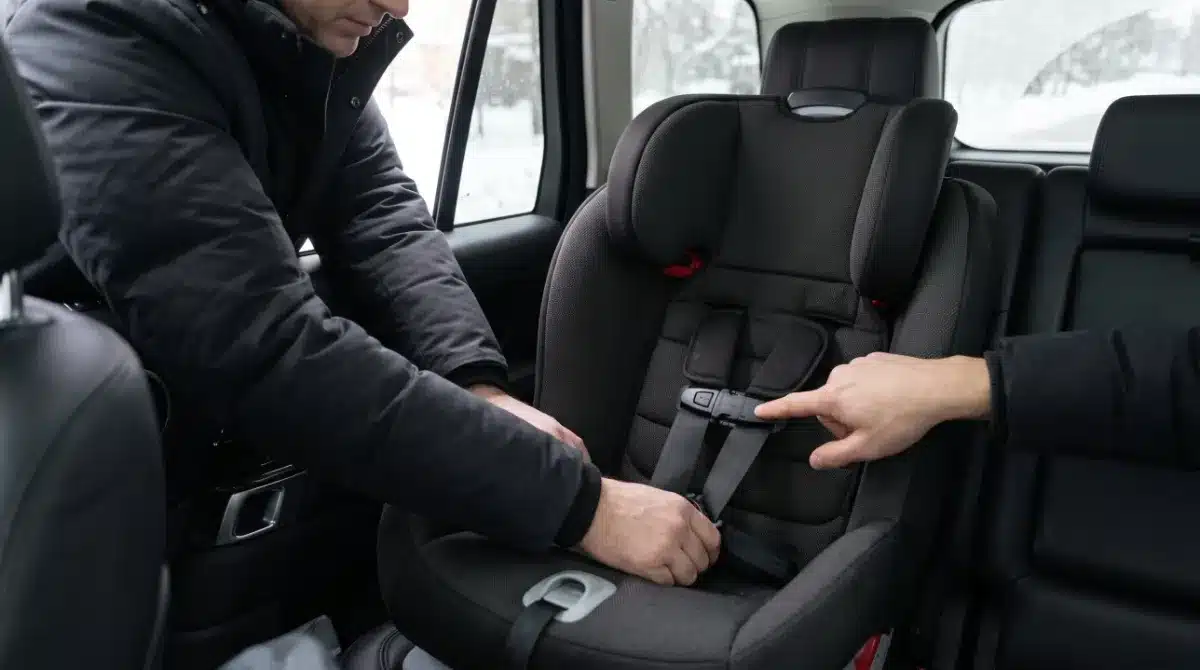
What our chauffeurs check on arrival: first, that the seat is fully installed. Then the one-inch rule: held at the belt path, the seat should not move more than one inch side to side or front to back. Finally, every seat is fully sanitized before a new family uses it.
Step 6: If your flight is delayed or cancelled
This is where the flight number earns its keep. A good provider watches inbound flights and shifts pickup times as delays post. But tracking is a backup. It is not a promise. The moment your plans change, call the provider directly. Do not assume tracking caught it, and do not wait until landing to mention a three-hour delay.
Flying out in winter? Our winter airport departure plan for families covers timing, packing and car seat decisions for snowy Pearson mornings.
On storm days, the order you communicate in is the order you get re-accommodated. The family that called at noon gets the adjusted 6 p.m. pickup; the family that waited until 5:45 gets whatever is left. Early communication costs nothing and buys everything.
Clarify two things at booking so delays never become disputes: how long the driver waits past the scheduled pickup time, and whether a rebooked pickup after a cancellation carries a fee. Ask your provider to confirm both in writing. Policies differ.
Questions worth asking before you pay
Not every provider runs their car seat programme the same way, and the differences matter more than the price gap between quotes. Ask these before you commit. A good company answers them easily.
- How are the seats cleaned between families? Ask whether covers are washed, how often, and what happens after a spill. “We wipe them down” and “covers go through the wash after every ride” are different answers.
- Are your seats within their expiry dates? The date is stamped on the seat shell. Any provider running a seat programme should know theirs are current without checking.
- Who installs the seats, and are they trained to do it? You want installation by someone who does it routinely, not whoever drew the short straw that morning.
- Is there an extra charge for the seat? Some include seats, some charge per seat, some per ride. None is wrong. But it should be stated upfront, not discovered on the invoice.
- What if my child outgrows the seat between booking and travel day? Growth spurts happen. Ask how late you can swap the seat type without a penalty.
- Can I bring my own seat instead? Many companies allow it and will install it for you. Confirm in advance, and make sure your seat carries the Canadian National Safety Mark for Ontario roads.
- Will you keep my 18-month-old rear-facing? Best practice is rear-facing as long as the seat allows. If the answer is “we only do forward-facing after one,” that tells you something.
- What exactly is included in the quoted price? Get the full breakdown in writing: the ride, the seat, airport fees, tolls, and any wait time. A quote that only names a single number invites surprises later.
- What is your wait-time policy at the airport? Flights land late and baggage carousels crawl. Ask how much grace time is included after landing and what the per-minute charge is after that. You do not want to learn the rate while standing at the carousel.
- What happens if our flight is cancelled and we rebook for another day? Some providers move the booking free of charge. Others treat it as a new booking. Know which one you are dealing with before you need it.
- How do I reach you on travel day if something changes? You want a dispatch number that gets answered, not a web form. Confirm whether you get the driver’s direct number and when.
- Should my child wear a winter coat in the car seat? No. Take the bulky snowsuit off before buckling. Thick coats compress in a sudden stop and leave the harness effectively loose. Dress the child in a thin fleece and lay the coat over the buckled harness like a blanket.
Frequently asked questions
How far in advance should I book a car seat limo in Toronto?
Book when you book your flights. Minimum 48 hours for a standard trip; a week or more around March break, Christmas, and long weekends, or whenever you need multiple seat types. Infant seats are the scarcest inventory. Families with babies should never leave it to the last day.
What if I don’t know my child’s exact weight?
Weigh them the week you book. A bathroom scale is fine. Do not guess: weight decides the seat category. On a boundary between two types, give the provider both numbers and ask. Experienced dispatchers recommend the more protective option.
Can the driver install the seat, or do I have to do it myself?
The provider installs the seat before arrival. That is what you are paying for. Your job is the two-minute verification: snug at the belt path, flat straps, chest clip at armpit level. If something needs adjusting, the driver handles it.
Do I need a car seat for a taxi or rideshare to Pearson?
The rules differ by vehicle type. Taxis, rideshares, and pre-booked private cars are treated differently under Ontario law. Our Ontario car seat laws guide breaks down which rules apply to which ride.
What happens if my child has a growth spurt before travel day?
Recheck the numbers the week of travel and call if anything changed categories. Swapping seat types is routine with notice. Ask at booking how late you can swap without a fee, so a growth spurt never becomes a travel-day surprise.
Is it safer to bring my own seat or use the provider’s?
Both are safe when done right. A provider’s seat saves you hauling yours through the airport. Just confirm it is current, undamaged, and Canadian-certified using the questions above. Your own seat brings familiarity, but it must carry the National Safety Mark for Ontario roads, and you carry it through the terminal. Many families split the difference: their own seat for the destination, the provider’s for the Toronto airport legs.
A booked seat is a verified seat
Four habits cover it. Know your child’s numbers. Name the exact seat type when you book. Give yourself real lead time, and spend two minutes checking the install before you roll. Do those and the car seat becomes the least dramatic part of travel day.
A note from VVIP Toronto Limo: child seats are part of our daily work, not an add-on we figure out on arrival. If you would like help with the ground leg, our car seat limo service in Toronto keeps the right seat installed and ready before the vehicle reaches you. You can check our rates and, when you are ready, make a booking. Safe travels.