
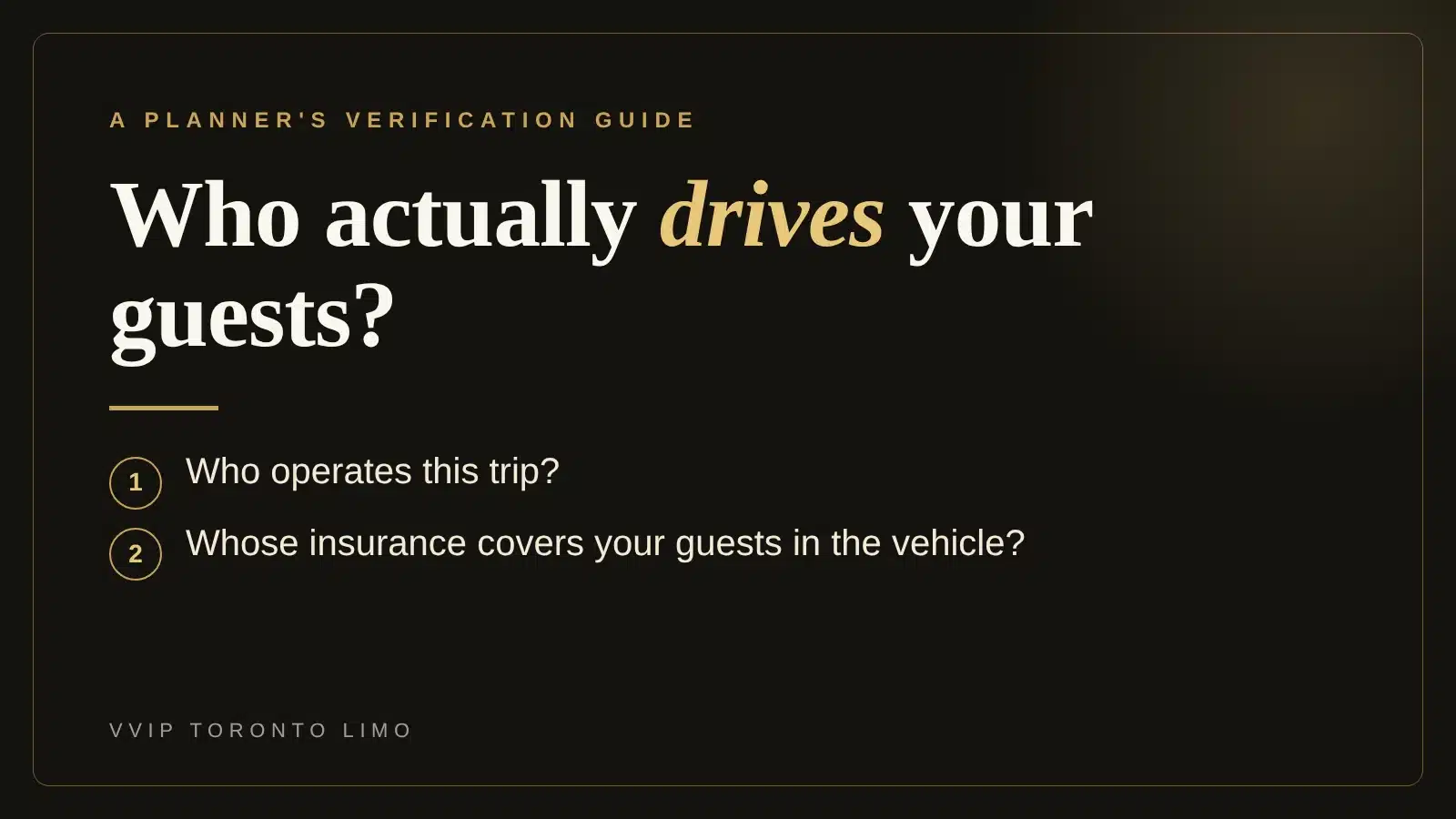
Forty guests wait in the lobby. The coach arrives, and the name on its side is not the name on your contract.
Who is driving them?
A polished website proves very little about a transport company. Some companies book programmes and then pass them to another operator without telling the client.
To verify a ground transport operator before you book, get two answers in writing: who operates this trip, and whose insurance covers our guests while they are in the vehicle. Then check the insurance documents against Ontario’s legal minimums and ask for the operator’s safety record.
This guide is for travel managers, executive assistants, event planners and destination management companies booking group or executive transport in the Greater Toronto Area.
The short version
Two questions, answered in writing:
- Who operates this trip?
- Whose insurance covers our guests while they are in the vehicle?
Four documents to keep:
- The agreement, naming the operator, with nothing subcontracted without your consent
- The insurance certificate, plus the endorsements
- A dated CVOR abstract or rating check for group vehicles
- Written confirmation of who owns the vehicles and who operates the trip
Why this lands on your desk. When you choose the vendor, that choice is part of your duty of care to the people you move.
If something goes wrong, the first questions are who was driving, who employed them, and what you checked before you booked. A short file of documents answers all three. Our guide to duty of care in ground transport covers the safety and tracking side.
A polished website proves very little about a transport company.
The fleet that was not theirs
The coach that pulls up carries a name nobody on your team has heard.
The company you paid arranged the trip. Someone else is running it.
Using another carrier is common and is not wrong in itself. Few operators own every size of vehicle. The problem is finding out on the day, when it is too late to check anything.
Who owns the vehicles and employs the chauffeurs?
Ask the question for each vehicle type on your programme, and get the answers in writing:
- Ownership. Who owns the vehicles, and who employs the chauffeurs?
- The name. What is the legal name of the company operating each leg? Have it written on the quote or the agreement.
- Subcontracting. Will any part of the trip be subcontracted? Ask for a clause that nothing is subcontracted without your written consent.
- Flow-down. If a partner carrier is approved, do the same standards flow down to it? That means the same insurance proof, the same safety record and the same documents.
- Coverage. If another carrier runs a leg, whose insurance covers your guests in that vehicle?
For the consumer side of this problem, see our guide to avoiding limo scams in Toronto.
The certificate that protected nobody
A certificate of insurance arrives as a PDF, goes into a folder, and nobody reads it.
After an incident, the planner learns it gave their organization no rights at all.
What does a certificate of insurance actually give you?
A certificate is a snapshot for information. It shows that a policy existed on the day it was issued. It grants the person holding it no coverage.
What protects your organization is how you are named on the policy.
| Term on the document | What it means for your organization |
|---|---|
| Certificate holder | You are told if the policy is cancelled. You are not covered. |
| Additional insured | You are covered under the vendor’s policy if you are sued over the vendor’s work. |
| Waiver of subrogation | The vendor’s insurer cannot pursue your organization to recover what it paid out. |
Is general liability the same as vehicle insurance?
No. Commercial general liability and automobile liability are separate policies.
A certificate that shows only general liability does not tell you what covers passengers in a moving vehicle. Ask to see the automobile liability limit as well, and read which policy is which.
What does Ontario law require?
Ontario sets minimum passenger injury insurance by seating capacity in Ontario Regulation 418/21 under the Highway Traffic Act, section 14. Amounts are in Canadian dollars.
| Passenger seats | Minimum insurance for passenger injury or death |
|---|---|
| 1 to 7 | $2,000,000 |
| 8 to 12 | $5,000,000 |
| 13 or more | $8,000,000 |
The same section requires $5,000 for damage to passengers’ property.
These are legal minimums, not recommendations. Some corporate buyers ask for higher limits in their contracts. That is contract practice, not law.
Two files that do not match
A planner lays a Toronto limousine’s paperwork beside a coach company’s and the numbers do not match.
Neither file is necessarily wrong. The two vehicles can sit under different rules.
Which rules apply to your trip?
| Your trip | Rules it sits under | What to ask for |
|---|---|---|
| A limousine licensed by the City of Toronto | The municipal licence. Toronto requires a limousine owner to file proof of $2,000,000 in commercial general liability insurance. | The municipal licence and a current insurance certificate |
| A coach or charter between municipalities, not under a municipal licence | The provincial table above | Insurance at the row for the vehicle’s seating, plus the safety record below |
The provincial regulation does not apply to municipally-licensed vehicles such as taxicabs and limousines, or to trips wholly within one municipality. That is why the first question is always what kind of trip you are booking.
Seat count matters too. In the provincial table, an 11 or 12 seat vehicle sits in the $5,000,000 row and a 13 or 14 seat vehicle sits in the $8,000,000 row. If your group is travelling by Sprinter van, ask how many passenger seats the vehicle has.
One detail worth knowing about Toronto. The City takes the insurance form from the insurer, signed and stamped, and not from the operator.
The record nobody checked
The quote was checked. The menu was checked twice.
The safety record of the company carrying forty guests was never opened.
In Ontario, operators of buses and heavier commercial vehicles hold a Commercial Vehicle Operator’s Registration, known as a CVOR. Carriers carry a safety rating on that record.
What should you ask a coach operator for?
Ask for a current Level 2 CVOR abstract, dated within the last 30 days.
An older abstract tells you how the carrier stood then, not now. Keep the copy with the date on it.
How do driving hours affect a multi-day programme?
Ontario’s hours of service regulation limits how long a commercial driver may work. A driver may not drive again that day after 13 hours of driving or after 14 hours on duty, and must take at least 10 hours off duty in a day.
A programme with a late gala and an early airport departure can run past those limits for one driver. Ask how the operator schedules its drivers across your days, and whether a second driver is planned.
Your home rules stop at the border
If you are booking Toronto from the United States, check the Ontario side of the file and not only the rules you know at home.
A carrier that crosses the border needs operating authority in both countries. For reference, the US federal minimum for interstate passenger carriers seating 16 or more is US$5 million.
If your group arrives through Toronto Pearson, our guide to executive airport transfers for international delegations covers the arrival itself.
Where we stand on both questions
These checks apply to us as much as to anyone. Here is where VVIP Toronto Limo stands on the two questions.
We carry $5 million commercial general liability insurance, and the certificate is available on request. Sedan, SUV and van work runs on our own fleet with our own chauffeurs.
Coach bus service is operated under a valid CVOR and insured to Ontario’s bus requirements.
The Planner’s Defence File
Four documents, kept together and dated, answer the questions that follow any incident.
- The agreement. It names the operating company and states that nothing is subcontracted without your written consent.
- The insurance. A current certificate, plus the endorsements that show how your organization is named.
- The safety record. For group vehicles, a dated CVOR abstract or rating check.
- The operator confirmation. A written statement of who owns the vehicles and who operates the trip.
One more thing to raise early: accessibility. Ask your delegates about accessibility needs when they register, not when they land.
Then pass those needs to the transport operator when you book the programme, not the week of the event. Wheelchair-accessible vehicles are a small part of any fleet. They are usually secured by advance arrangement, and sometimes they come from beyond the operator’s own vehicles.
The operator who knows early can plan. The one who hears late often cannot.
Confirm the operator’s policy on alcohol on board as well.
This guide is general information, not legal advice. Vendor contracts, including their indemnity and cancellation terms, deserve a review by your own legal counsel.
Frequently asked questions
How do I confirm who is actually operating my trip?
Ask for the legal name of the operating company for each leg and have it written on the quote or agreement. Ask who owns the vehicles and who employs the chauffeurs. Add a clause that nothing is subcontracted without your written consent.
Is a certificate of insurance proof that my organization is covered?
No. A certificate is an informational snapshot and gives the holder no coverage. Your organization is covered only if it is named as an additional insured on the vendor’s policy. A certificate holder is simply told if the policy is cancelled.
How much insurance must a passenger vehicle carry in Ontario?
Ontario Regulation 418/21 sets minimum passenger injury insurance at $2,000,000 for 1 to 7 passengers, $5,000,000 for 8 to 12, and $8,000,000 for 13 or more, plus $5,000 for passengers’ property. The regulation does not apply to municipally-licensed vehicles or to trips wholly within one municipality.
What is a CVOR abstract and how recent should it be?
A CVOR abstract is the record of an Ontario commercial vehicle operator, including its safety rating. Ask a coach operator for a Level 2 abstract dated within the last 30 days, and keep the dated copy.
Is it a problem if a transport company uses partner carriers?
Not in itself. What matters is that you are told before you book, that the operating carrier is named in writing, and that the same insurance and safety checks apply to that carrier.
Do the same rules apply to a Toronto limousine and an inter-city coach?
Not always. A limousine under a City of Toronto licence sits under the municipal rules, which require proof of $2,000,000 in commercial general liability insurance. A coach or charter travelling between municipalities sits under the provincial table.
Planning a programme in the GTA?
Bring these questions to any operator you are considering, including us. Our corporate car service in Toronto page sets out how we handle business accounts and group travel.
