
Navigating Ontario’s child safety regulations can be frustrating for any parent, especially when planning travel. The rules often seem to shift when you move from your personal vehicle to a commercial one. Is it legal to ride in a taxi without a car seat? Does that same rule apply to a luxurious Toronto airport limo? What are the actual weight and age requirements for each stage?
Unsure Which Car Seat Your Child Needs?
Don’t guess when it comes to safety. Our experts provide the correct, sanitized seat based on your child’s current weight and age. Book your safe transfer today.
As a premier provider of GTA airport limo taxi service with car seat, VVIP Toronto Limo believes that “legal” is not the same as “safe.” We are committed to maximum protection, not just meeting the minimum legal standard. This guide is your definitive cheat sheet to understanding the 2026 regulations and our stricter internal safety protocols.
The Legal Landscape: Limos vs. Taxis in Ontario
One of the biggest misconceptions in the GTA is that all commercial vehicles share the same exemptions.
- Taxis (Beck Taxi, etc.): Ontario law currently exempts taxi drivers from ensuring a child is secured in a car seat if one is not provided by the parent. This exemption exists because taxis are “on-demand” and may not have the logisitical capacity to carry various seats.
- Limousines and Professional Livery: This is where the confusion peaks. While some interpretations of the Highway Traffic Act include limousines in this exemption, VVIP Toronto Limo operates on a pre-booked basis. We have the specific capacity to provide and install the correct seat before we arrive.
Relying on a technical legal exemption in a high-speed environment like the 401 is simply not worth the risk. A professional stress free family travel via Toronto Pearson experience should always prioritize a properly installed, age-appropriate seat.
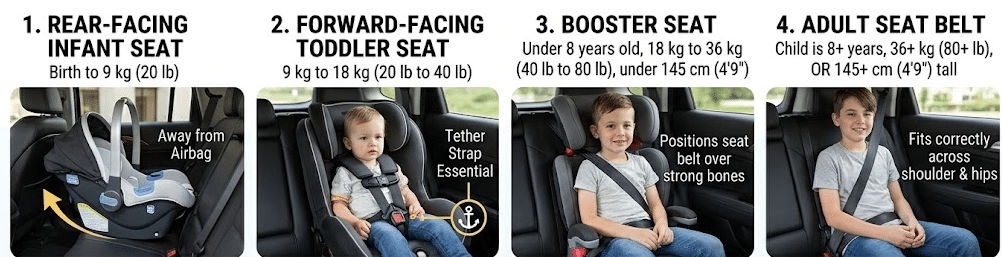
The 2026 Child Safety Cheat Sheet (by Weight & Age)
These guidelines apply in all vehicles in Ontario, but we emphasize that hospital homecoming limo Toronto infant safety demands adherence to the strictest standards.
Stage 1: Rear-Facing Infant Seat
- Who: Newborns and infants up to approximately 1 year old.
- Legal Minimum: Must be used until the child weighs 9 kg (20 lbs).
- Best Practice (The VVIP Standard): We strongly recommend keeping your child rear-facing as long as possible, ideally until they reach the maximum weight or height limit of the convertible car seat (which is often 18 kg or 40 lbs). This protects a newborn’s delicate spine in a front-end collision.
Stage 2: Forward-Facing Toddler Seat
- Who: Children approx. 1 to 4 years old.
- Legal Minimum: Must be used from 9 kg (20 lbs) up to 18 kg (40 lbs).
- Best Practice: The child must be able to walk unassisted and have sufficient neck strength. They should remain in a 5-point harness forward-facing seat until they are at least 4 years old and meet the minimum weight and height for a booster.
Stage 3: Booster Seat
- Who: Children approx. 4 to 8 years old.
- Legal Requirement: Must be used from 18 kg (40 lbs) until the child is 8 years old, or weighs 36 kg (80 lbs), or is 145 cm (4’9″) tall.
- Crucial Note: It is a mistake to move a 3-year-old to a booster just because they meet the minimum weight. A booster seat relies on the car’s existing seat belt, and a young child cannot maintain the correct position necessary for that belt to be effective in an accident.
Stage 4: Seat Belt Only
- Who: Children approx. 8+ years old.
- Requirement: Children can move to a seat belt alone only when the shoulder belt sits across the middle of the chest (not the neck) and the lap belt sits low across the hips (not the stomach).
The Internal Safety Checkpoint: How We Verify Installation
A car seat is only effective if it is installed correctly. Our chauffeurs undergo specialized training to handle the hardware and verify a safe installation. We don’t just “loop the belt through.”
- The “One-Inch Rule”: We grab the car seat at the belt path and ensure it does not move more than one inch (2.5 cm) in any direction.
- Top Tether Verification: For all forward-facing seats, we ensure the top tether strap is properly secured to the vehicle’s designated anchor point, a step that is often skipped.
- Tightly Buckled: We ensure the car’s seat belt (or LATCH/UAS system) is fully tightened, often using our own body weight to compress the seat into the vehicle’s upholstery.
Frequently Asked Questions: Car Seat Laws GTA
Can a 1-year-old legally forward face in a limo in Ontario?
Technically, Ontario law allows a child to forward face once they reach 9 kg (20 lbs), which often happens around 1 year of age. However, best practice is to keep a child rear-facing as long as possible, ideally until they reach the maximum weight limit of their convertible seat (40 lbs or more).
Is it true that taxis are exempt from car seat laws in Toronto?
Yes. Ontario law exempts taxi drivers from ensuring a child is secured in a car seat if one is not provided by the parent. This exemption does not apply to pre-booked limo services that have the capacity to provide and install seats.
What is the weight required for a child to use a booster seat in Ontario?
Children must weigh at least 18 kg (40 lbs) before they can transition to a booster seat. They must remain in a booster until they meet one of the requirements: 8 years old, 36 kg (80 lbs), or 145 cm (4’9″) tall.
Does VVIP Toronto Limo verify the car seat installation?
Absolutely. Our chauffeurs are trained in car seat safety and perform an internal safety check, ensuring the seat passes the One-Inch Rule and that the top tether is secure before you place your child in the seat.
Conclusion: We Are Your Partners in Safety
Ontario’s car seat laws are complex, but our mission at VVIP Toronto Limo is simple: to remove the confusion and provide the safest possible transportation for your family. We do not rely on legal loopholes; we rely on logic and advanced safety technology.
When you book your next comparison between Beck Taxi vs VVIP Toronto Limo, remember that a professional chauffeur is not just a driver; they are a partner in ensuring that every member of your family, no matter how small, is properly secured.